An Educational Resource from California Safe Schools

Stop Diesel Idling
Improve Air Quality In Your Community
An Educational Resource from California Safe Schools
Improve Air Quality In Your Community
Diesel exhaust is classified as carcinogenic to humans IARC, 2012.
70% of California’s known cancer risk from toxic air contaminants is linked to diesel emissions.
Diesel Particulate Matter Health Impacts. California Air Resources Board
Children are especially vulnerable: diesel pollution can cause asthma, reduced lung capacity, allergies, ear infections and leukemia.
Sick of Soot: Solutions to California's Diesel Pollution, Union of Concerned Scientists
Liu, K., Zhang, H., Bo, Y., Chen, Y., Zhang, P., Huang, C., Yu, Z., & Gao, Z. (2024). Ambient air pollution and children’s health: An umbrella review. Atmospheric Pollution Research, 15(6), 102108.
Unnecessary idling wastes fuel and contributes to air pollution that affects everyone — drivers, students, and surrounding communities alike.
Heavy Duty Diesel Vehicle Idling Information - California Air Resources Board
Airborne Toxic Control Measure to Limit Diesel-Fueled Commercial Motor - Vehicle Idling - California Air Resources Board
When you observe a Diesel Vehicle or Truck Idling for more than
5 minutes, Call 1-800-CUT-SMOG or Use the Online Complaint Form. Have this information ready:
District 6 serves as a vital industrial center for both the City of Los Angeles and the State of California. Sitting at the intersection of numerous highways and railways, the district is an ideal location for distribution centers, airports, and industrial facilities. The district's commercial appeal has attracted investors, created jobs, increased tax revenue, and stimulated economic growth.
District 6 is one of the most polluted regions in California. Diesel-powered trucks and trains emit toxic particulate matter as they travel through local neighborhoods everyday. In Van Nuys, private jets disperse harmful lead particles over nearby houses and schools as they takeoff and land at one of the worst polluting airports in the country. In Sun Valley, a power plant leaked methane gas for years without notice .
The combination of these environmental hazards forces District 6 residents to contend with some of the highest rates of pollution-related illnesses in the state, ranging from acute respiratory illnesses to cancer and even premature death. Children are especially vulnerable to these environmental hazards, as exposure to lead and other toxic particles in early childhood can (and do) have lifelong consequences.
And these consequences can span generations.
District 6 is home to more than 200,000 residents and ranks in the top 10% statewide for overall pollution burden. Residents face air pollution levels higher than 90% of California communities, with neighborhoods located near freeways, warehouses, and industrial corridors. Diesel trucks and buses frequently idle their engines while parked or waiting—releasing toxic exhaust where children learn and play
Diesel idling adds to the area’s heavy environmental burden, especially near schools and sensitive sites.
City and Community Health Profile - Los Angeles City Council District 6 Report
Reducing idling means: • Cleaner, safer air for children, families and all residents.
• Stronger compliance with California’s idling restrictions.
01/12
The Diesel Idling Deterrence: Signage, Enforcement, and Education project in Los Angeles City Council District 6 (CD6) represents a targeted effort to combat air pollution from truck idling in disadvantaged San Fernando Valley communities.
Led by California Safe Schools (CSS), the initiative seeks to install "No Idling" signs at 80 strategic locations within 100 feet of sensitive receptors—such as schools, daycares, homes, and senior residences—while incorporating educational campaigns to encourage community awareness and driver compliance. This approach addresses the disproportionate diesel particulate matter (DPM) exposure in neighborhoods like Sun Valley, Panorama City, and Van Nuys, where industrial warehouses and truck routes exacerbate health risks including asthma, cardiovascular disease, and cancer, particularly among children and the elderly.
Building on California’s statewide 5-minute idling restriction for heavy-duty diesel vehicles (Title 13, California Code of Regulations, Section 2485) and the California Air Resources Board’s Airborne Toxic Control Measure to Limit Diesel Vehicle Idling, which prohibits unnecessary idling and requires engines to be shut off when not in use, the project aligns with broader environmental justice goals under Assembly Bill 617 (AB 617), which mandates community emissions reduction programs in high-burden areas. CD6, covering approximately 30 square miles with a population facing 21st-percentile scores in the Healthy Places Index for clean environments, ranks high in CalEnviroScreen 4.0 pollution burdens, with Sun Valley tracts often exceeding the 90th percentile for DPM due to proximity to I-5, recycling facilities, and distribution centers.
References underscore the need for visual reminders like signs, which studies indicate can reduce idling behavior by 20-50% when paired with enforcement, drawing from analogous initiatives in Wilmington and East LA under SCAQMD's AB 617 steering committees.
Site selection for the 80 signs prioritizes hotspots identified through community input, GIS overlays of truck routes (e.g., Van Nuys Blvd, San Fernando Road) and receptor directories, ensuring placements at warehouse entrances and loading docks within 100 feet of vulnerable sites. For instance, Panorama High School abuts loading docks at The Plant warehouse (<50 feet), while Sun Valley schools like Roscoe Elementary border arterial routes with documented 10-15 minute idling durations.
Health impacts are well-documented: idling emits pollutants equivalent to driving 30 miles per hour, wasting 0.5-1 gallon of fuel and contributing to smog and climate change, with economic burdens like elevated healthcare costs in low-income areas.
References from public health reports highlight increased respiratory hospital visits in CD6, supporting the project's focus on seven high-impact schools for participation in outreach and sign installation.
Regulatory references, including CARB's heavy-duty vehicle idling information and local council files like CF 19-0454, provide enforcement frameworks, with 2025 updates such as AB 735 mandating 500-foot buffers for new warehouses.
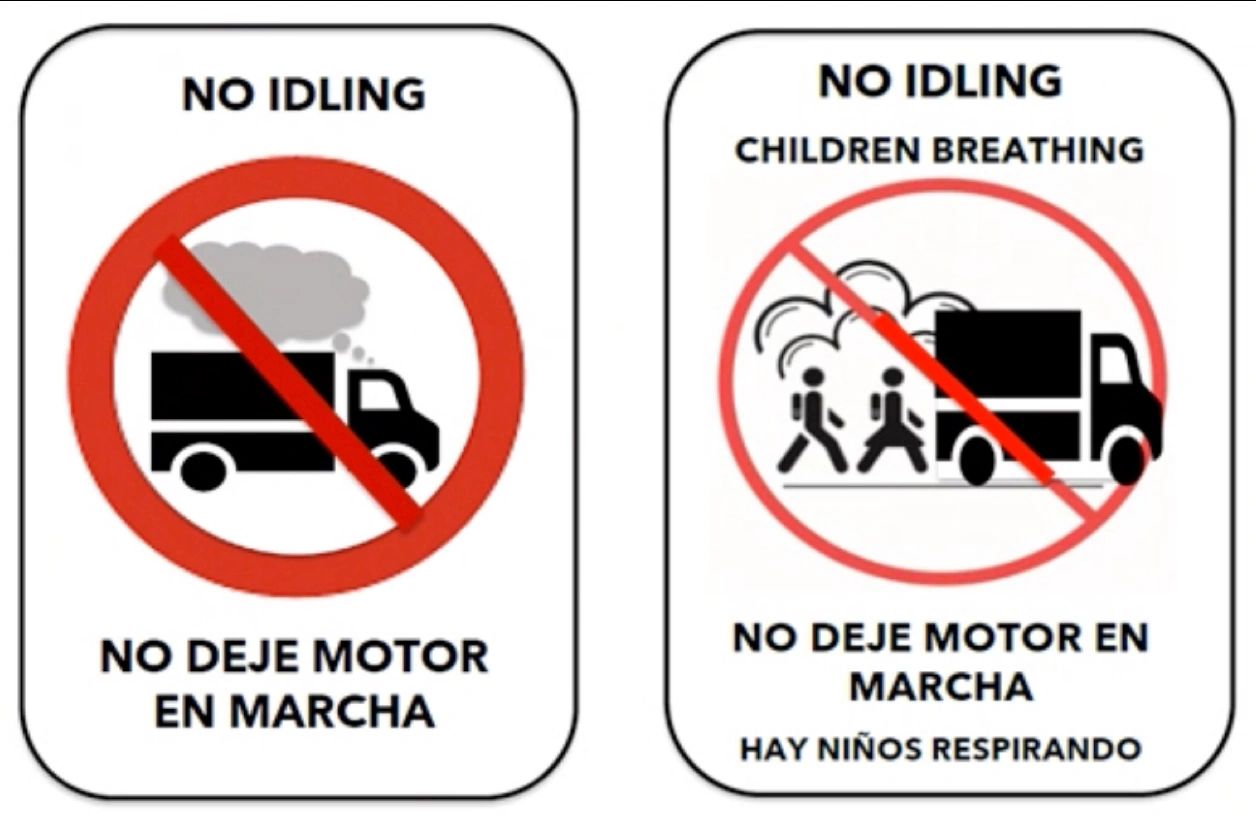
Help us find locations for No Idling Signs.
Send cross streets where you are observing diesel idling.
Founded in 1998, California Safe Schools (CSS) is a nonprofit organization dedicated to protecting children’s health and the environment by promoting safer school environments, advancing environmental justice, and eliminating toxic exposures in schools and communities. CSS’s groundbreaking policies and advocacy have shaped statewide and national reforms that continue to protect millions.
Has this website been helpful to you?
Let us know - write to us at calisafe@earthlink.net
The Diesel Idling Deterrence: Signage, Enforcement, and Education project in Los Angeles City Council District 6 is supported by the “California Climate Investments” (CCI) program, a statewide initiative that puts billions of Cap-and-Trade dollars to work reducing greenhouse gas emissions, strengthening the economy, and improving public health and the environment—particularly in disadvantaged communities.
Disclaimer: The views and opinions expressed in this product, presentation, or material funded by the Community Air Grant (CAG) are those of the CAG Grantee [org/tribe] and do not necessarily reflect the views, policies, or positions of CARB or the
State of California.


We use cookies to analyze website traffic and optimize your website experience. By accepting our use of cookies, your data will be aggregated with all other user data.